What is a hardened aircraft shelter? A glossary entry for imagery analysts
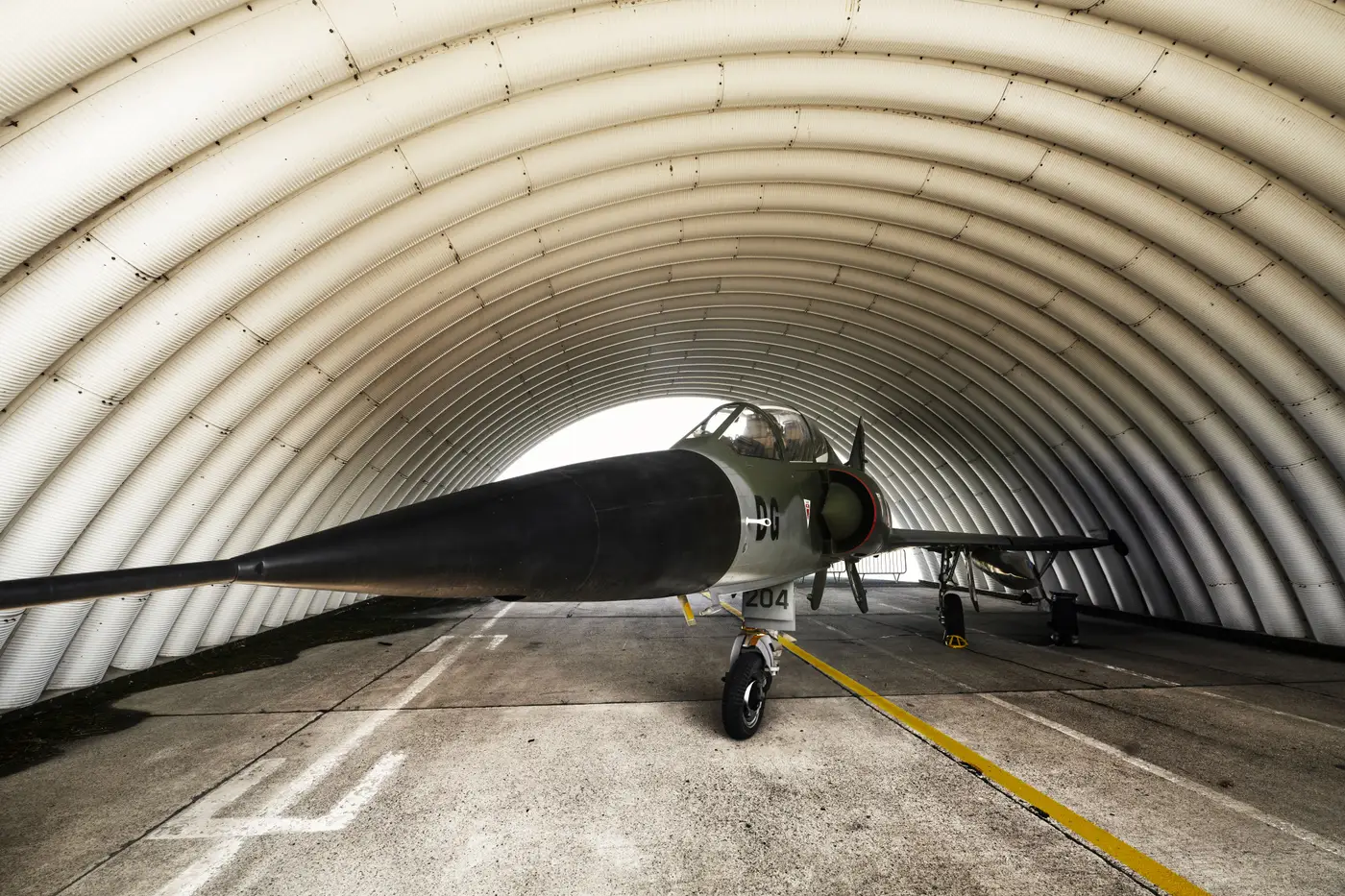
A hardened aircraft shelter, usually shortened to HAS in order-of-battle notes, is an individual structure built to protect a single parked aircraft from blast fragmentation, small-arms fire, and overhead attack. Most are reinforced concrete arch or box structures, earth-covered on top and sides, with a steel or concrete blast door at one or both ends. The shape reads as a mound with a dark mouth on medium-resolution imagery, and as a ribbed concrete arch once you're down in the 30-50cm range.
The design dates to Cold War NATO and Warsaw Pact doctrine, when dispersing fighters into individually hardened bays was the answer to runway-cratering attacks that could otherwise pin an entire wing on open ramp. The logic hasn't changed much since. A single HAS protects one aircraft from a near-miss that would otherwise take out everything within fragmentation radius on open apron.
HAS vs open revetment: what the imagery actually shows
An open revetment is the cheaper cousin: an earthen or sand-filled barrier wall, usually U-shaped or chevron, with no roof. It stops horizontal blast and fragmentation from an adjacent hit but does nothing against a direct strike or an attack from above. You'll see these as three-sided earthworks with the aircraft tail or nose visible inside, because there's no overhead cover to hide it.
The practical difference for anyone counting aircraft off a time series: an open revetment usually lets you identify aircraft type and sometimes tail number from directly overhead. A closed HAS with the doors shut gives you nothing but the shelter footprint itself. Occupancy has to be inferred from indirect signs, ground vehicle activity near the doors, fresh tire tracks on the apron in front, shadow cues if the doors are cracked open, or a consistent pattern of which shelters cycle vehicles and which never do.
That's also why shelter counts and apron counts get reported separately rather than folded into one number. A base with forty HAS and twelve aircraft visible on open apron isn't a forty-aircraft base. It could be a four-aircraft base with the rest tucked away, or a base running close to capacity with doors shut for maintenance. The shelter count tells you capacity and posture investment. The apron count tells you what's actually sitting out where you can see it. Neither number alone answers the question.
Aircraft shelter construction: what changes on site, and when
New HAS construction follows a fairly recognizable sequence on successive imagery passes: site grading and a rectangular excavation, then the arch or box formwork going up (visible as a lighter poured-concrete footprint before the earth cover goes on), then the earth mounding itself, and finally a taxiway spur connecting the shelter to the main apron or taxiway network. The whole sequence typically runs weeks to a few months depending on the shelter design and how many are being built in parallel. A base adding a new shelter row is one of the more reliable signals that a unit expects to be flying more sorties, or expects to be hit, from that location going forward.
Runway and taxiway work gets tracked the same way, because shelter construction rarely happens in isolation. A new blast-resistant row paired with runway resurfacing or a new parallel taxiway is a stronger signal than either on its own.
None of this is hard to spot once you know the shape. The tedious part is doing it every day, for every base on your list, by hand, scrolling back through archive tiles to remember what was there last week. Airfield Activity keeps a running log of exactly these things per named airfield: apron and revetment counts by aircraft type, shelter and runway construction tracked over time, laid out as a day-over-day comparison so you're reading what changed rather than re-deriving it from two separate dates. If you're already doing this count by hand, it might be worth seeing what a daily log looks like instead.